
Knowledge within power
Apparatuses of knowledge and power

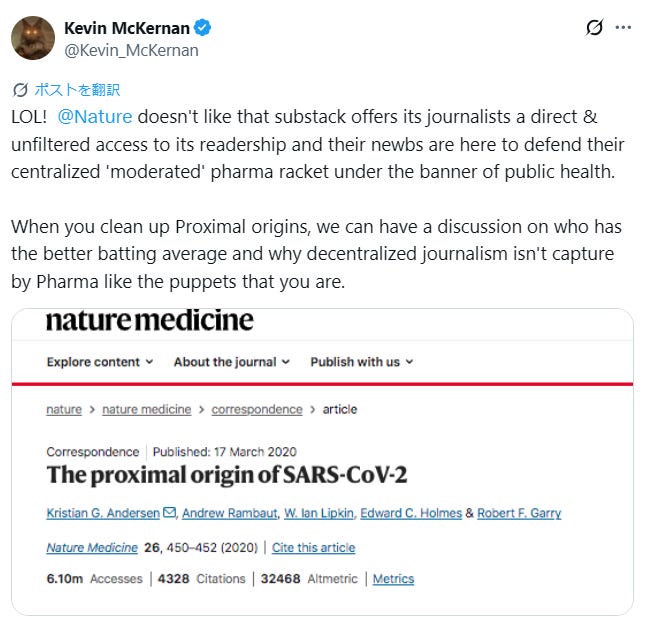
In recent years, academic journals such as Nature have begun to suppress scholarly discourse taking place on decentralized media platforms. In contemporary society, academic journals no longer function merely as neutral intermediaries of knowledge, but rather operate as “apparatuses of knowledge and power.”
The Nobel Prize is no exception to this.
These academic authorities reproduce existing institutional legitimacy by selecting and controlling the circulation of what is considered valid knowledge. As a result, genuinely autonomous thinking and the circulation of knowledge outside institutional frameworks are excluded. Central journals like Nature and awards like the Nobel Prize exemplify this very “monopolization of knowledge.”
https://x.com/RWMaloneMD/status/1973096898211770656

https://x.com/Kevin_McKernan/status/1973162670091022580
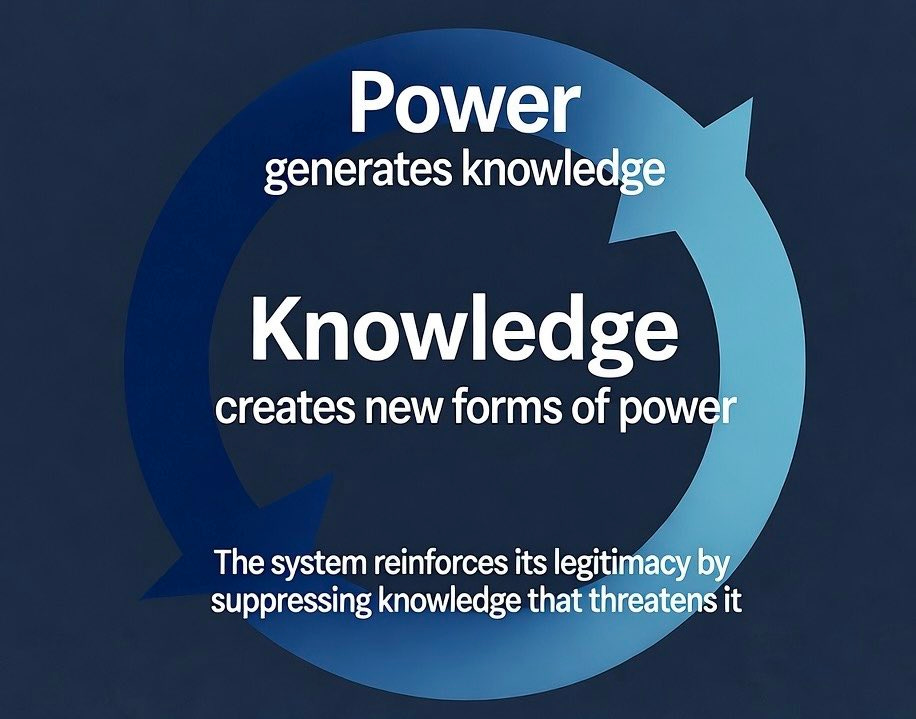
Knowledge within power is never neutral or universal. As the French philosopher Michel Foucault demonstrated, knowledge is intertwined with power, and the two circulate in a mutually complementary relationship. Power produces knowledge, and that knowledge generates new forms of power, through which the system eventually reproduces its inherent legitimacy.
Within this cyclical structure, the system reinforces its legitimacy precisely by excluding and denying knowledge that threatens it. In this context, knowledge is no longer the pursuit of truth, but becomes a function that serves the maintenance of the system.
When the peer review process is incorporated into the system, it ceases to be a practice of evaluating the truth or validity of knowledge, and instead transforms into a technique of power that selects knowledge and controls its circulation. In Foucauldian terms, it is an apparatus that serves the “regime of truth,” and academic neutrality is inevitably lost in this process.
Journals at the core of the system no longer function merely as academic media, but rather as “apparatuses of power that monopolize the circulation of knowledge.”
In Kant’s view, “enlightenment” means “having the courage to use one’s own reason without relying on authority.” If science is truly an enlightened endeavor, it must be grounded in the autonomous exercise of reason, independent of external apparatuses of power.
Therefore, what is urgently required in contemporary society is the reconstruction of a “knowledge ecosystem” that bypasses institutional authorities such as peer review and academic journals, and remains independent of the system.
What should be placed at the center of this “knowledge ecosystem” is not institutionally guaranteed neutrality, but the open publication of research results based on autonomous thinking and a space where those results can be freely verified and reproduced.
In other words, this is an attempt to separate science from the system and to attribute it to thought itself. It means restoring Kant’s concept of “publicity” and affirming that scholarship exists not for the system but for reason.
If many scientists were able to abandon the privileges of academic authority and power and transfer knowledge to independent and free platforms or spaces for discourse, existing journals would rapidly lose their significance and become mere shells. This would be nothing less than the “loss of the monopoly over knowledge” that journals fear most.
However, reality is harsh. As Foucault depicted, power and knowledge form an inseparable structure, and in modern society, the overwhelming majority of scientists remain subordinate to journals, using their authority as the basis for their own legitimacy. Therefore, the vision of “liberating knowledge” remains an unattainable fantasy.
Yet, I believe that it is only by confronting this very impossibility that new possibilities open up beyond the system.
Let's look at former Chemist Jack Leeming who talks about online Pigs and Endotoxin Student Hannah Docter-Loeb
https://geoffpain.substack.com/p/nature-careers-constructing-hit-pieces
Sorry, but that was not limited to recent years. Speaking of medicine and sports science Honorius (r. 395-423) legally ended gladiator games because of the "resurrections" of wounded gladiators. Jakob Fugger took advantage of Paracelsus' claim the dose makes the poison - an excellent excuse for working in mines.